

IB Solutions runs on an EOS-inspired operating system. At the center of it is our growth strategy document, a five-page playbook covering vision, positioning, services, content plans, and campaign backlogs. It changes almost daily as strategy takes shape through real work.
Keeping it current used to mean a manual loop: ask ChatGPT for edits, stitch them into a Google Doc by hand, export, re-upload, confirm. We built a custom AI agent that edits the document with us instead. Strategy work that used to stall on file management now happens in one place, about twice as fast.
The agent at a glance
The problem
The original setup used ChatGPT's project feature. The strategy document was uploaded as permanent context, so every planning conversation could reference it. That part worked.
The friction came from updates. Planning sessions often improved the document itself: a sharper service description, a new backlog item, a restructured section. Each improvement triggered the same loop. Ask ChatGPT for the edits, open the document in Google Drive, stitch the changes in by hand, export, go back to the project settings, re-upload, confirm. On busy days this happened three or four times.
It got worse when we asked for a full updated document instead of surgical edits. ChatGPT reliably wiped unrelated sections. A paragraph in Section 7 would vanish because we asked it to improve Section 2. The longer the document grew, the more destructive the edits became, and the more time we spent checking for damage.
We were spending more time managing files than working on strategy.
What we built
We built a custom AI agent inside Void Crystal, our internal AI R&D lab. It removes the manual loop completely.
A shared workspace
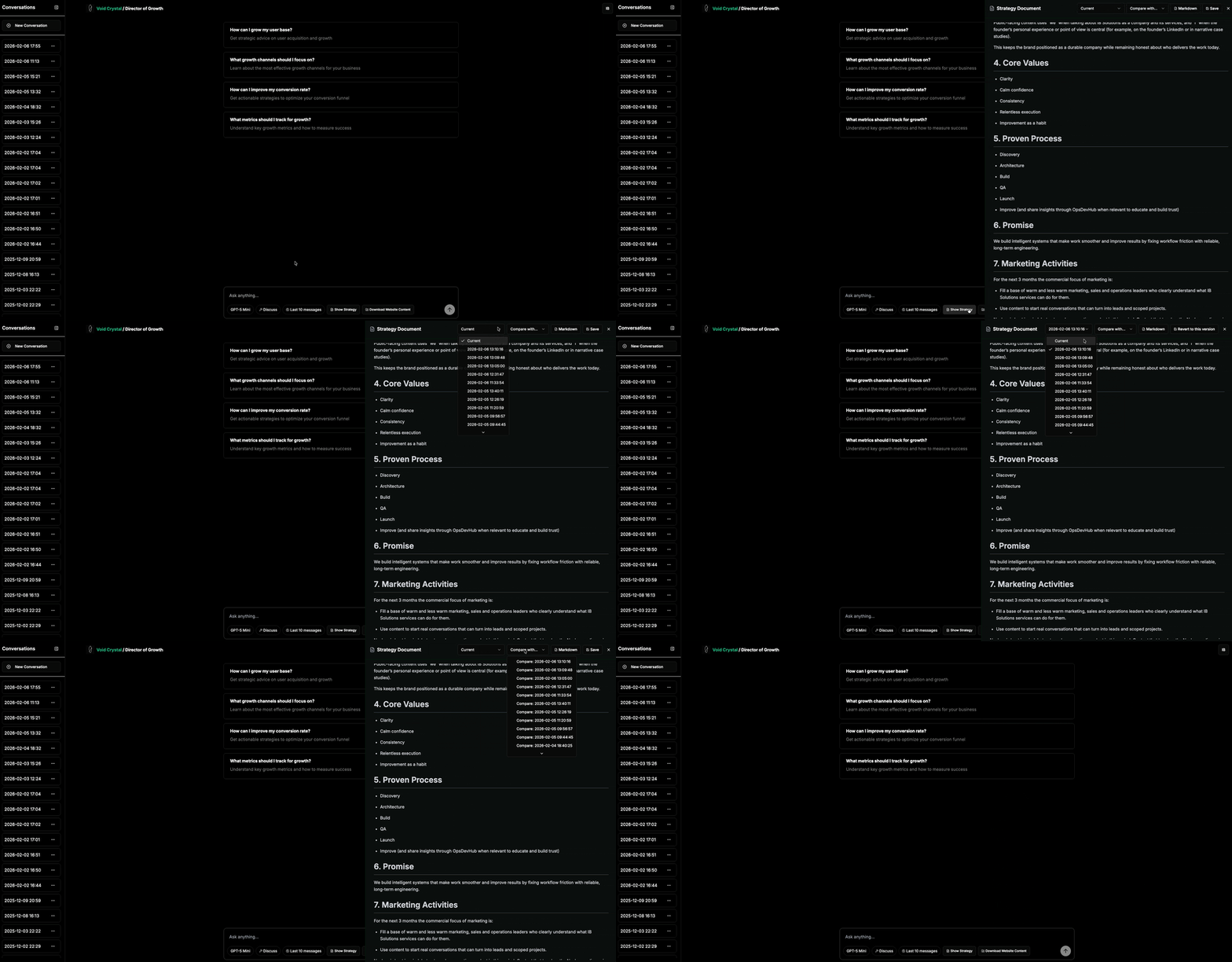
The agent gives us a chat interface with a sliding document panel. Both the human and the agent work on the same living document at all times. Slide the panel open, read or edit any section directly, and the changes sync to the agent's context. The agent edits the same document, and its changes sync back automatically.
No exporting, no re-uploading, no switching between tabs. The document and the conversation live in the same place.
Section-scoped editing
This was the hardest problem to solve and the most valuable thing that came out of the project.
Early versions of the agent had the same destructive editing habit as ChatGPT. Even with direct document access, it would drop paragraphs and rewrite sections it was never asked to touch. We tried automatic detection that rejected edits when too much content was removed, and validation checks that flagged suspicious deletions. They helped, but they made the workflow tedious. The agent would fail, get rejected, retry, and fail again.
The fix was forcing the agent to think in sections. Before it writes a single character, it has to name the sections it intends to edit and say why. Then it locks itself to those sections. Everything outside the declared scope stays untouched.
This one change removed nearly all destructive edits. It also made the agent's reasoning visible: you can see which sections it plans to touch, and why, before anything changes.
Version control and rollback
Every edit creates a new version. You can compare any two versions side by side to see exactly what changed, and revert to any earlier state in one action. Even with section scoping, a safety net and a clear record of how the document evolved are worth having.
Model switching for cost control
Most conversations with the agent are discussions, not document edits. The agent runs on the OpenAI API, which lets us pick the model per task. Early on, every turn used the most capable and most expensive model. A single planning session could cost several dollars, with heavy editing tasks at $0.30 to $0.60 each.
Now strategic editing routes to a capable model, and discussion, brainstorming, and quick questions route to a lighter one. Routine tasks dropped to $0.03 to $0.06, about 10x cheaper, with no visible drop in quality.
Conversation history is the second cost lever. By default the agent sends the full conversation to the API, which is the most context and the most tokens. For a quick brainstorm or a standalone question, a toggle limits it to the last ten messages. ChatGPT does not expose that control at all, and on long sessions the savings add up.
A mode toggle
About 95% of the time, the agent correctly read whether we wanted to talk something through or edit the document. The other 5% was annoying enough to fix: it would start editing when we wanted to think out loud, or start chatting when we needed the file updated. Rather than over-engineer the prompt, we added two buttons, Discuss and Edit document. One click removes the ambiguity. As models get better at reading intent, the toggle will probably retire itself.
What changed
Co-working on the growth strategy document is about twice as fast. The export-edit-upload loop is gone, and the document stays current because updating it no longer means leaving the conversation.
The bigger change is how we plan. When keeping the document current costs nothing, it actually gets used. Ours is updated in real time and referenced in every planning conversation, so decisions run against the latest thinking instead of last month's export.
Where the same pattern helps
None of this is specific to our strategy document. The pattern fits any team that maintains a living operational document and wants AI help keeping it current without the usual risks.
Marketing directors run campaign briefs, editorial calendars, and brand guidelines that evolve as work progresses. Section-scoped editing means an AI can update the brief after a campaign review without touching the positioning section that was finalized last week.
Sales leaders maintain battlecards, territory plans, and pipeline playbooks. The document is important enough to keep current and tedious enough to drift. An agent that edits specific sections on request, and shows exactly what changed, turns maintenance into a conversation.
Operations managers can keep SOPs, process documentation, and onboarding guides current as processes change. Version control and rollback make every update reversible, which lowers the risk of delegating documentation to an AI.
Founders running on EOS or a similar framework will recognize the problem immediately. Section scoping plus version control means the operating document gets updated during the planning session, not weeks after it.
Where this lives
The agent is one of the demos in Void Crystal, our internal lab for testing where AI delivers practical value for marketing, sales, and operations.
The section-scoped editing technique is headed for Void Fragments, the lab's open source companion, as a standalone pattern for any agent that needs to change part of a long document without corrupting the rest.
What this means
The gap between AI that could help with strategy and AI that actually does comes down to workflow friction. Assistants that lose context, need manual file management, or break what they were not asked to touch create enough drag that teams stop using them for anything that matters.
Remove the drag and the strategy document changes role. It becomes the surface where planning, execution, and documentation happen together. The judgment stays human. The agent clears the file management out of the way.

Want an AI agent that works with your operational documents?
We build custom AI systems that fit into the way your team already works. No generic chatbots, no blown-out scope.
Related Products:
-
 PhantomSwarmPhantomSwarm is the operating layer for a business run by AI employees: the roster, the task board, and the record of every task, on top of the systems you already run. Built and maintained by IB Solutions.
 -
 The AI Growth Operating SystemThe AI operating system behind IB Solutions' own growth. Strategy, playbooks, and voice rules live as files an AI director runs on our existing tools. We build slices of it for founder-led companies, starting with CRM Intelligence: fixed scope, fixed price, on your stack.